



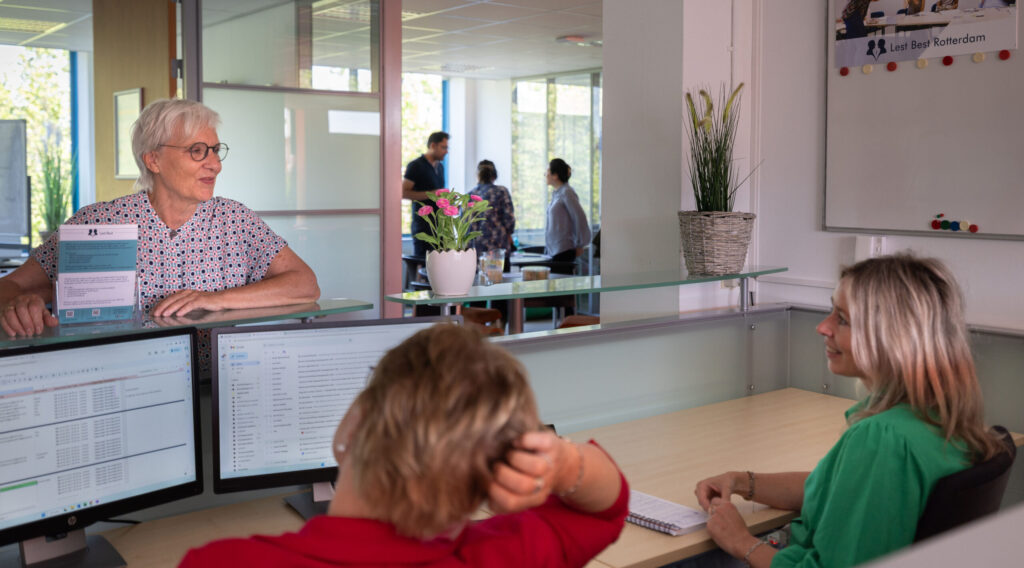



The Invisible Meeting Before the Meeting
So, you’re sitting at your office desk. You’ve prepared your slides, you have your data ready, and you’re waiting for the big meeting at two o’clock. That’s where the decisions happen, right?
Well, here’s the thing. According to research from the European Commission, a huge chunk of office communication actually happens in the informal spaces. It’s the twenty minutes before the meeting starts, while people are standing around the coffee machine or walking together in the hallway. This is the invisible meeting. This is where people test out ideas, share their concerns, and basically decide what they’re going to say in the actual meeting later. If your Dutch is just at a survival level, you’re basically locked out of these moments. You arrive at the meeting only to realize that the decision is already leaning in a certain direction before you even sat down.
Cursussen💡 The real decisions often happen during informal chats before the official meeting starts. If you’re not fluent in the Dutch between the words, you’re missing the chance to influence the outcome before the boardroom doors even open.

This is why an intensive Dutch course is about so much more than just learning how to write an email. You need to be able to jump into a fast conversation about a weekend trip or a tiny office problem so that when the conversation shifts to a work project, you’re already part of the group. Without that ability to communicate spontaneously, you remain a guest in the office rather than a member of the team. You’re missing the secret engine that drives the company. By stepping into a Dutch intensive course, you give yourself the tools to stand at that coffee machine with confidence. You stop being the person who just shows up for the official part and start being the person who helps shape the plan before the clock even strikes two.

The Cultural Poldermodel
In the Netherlands, there’s this famous concept called the Poldermodel. It sounds like something from a history book, but it’s actually the way many Dutch offices functions today. It’s the idea that everyone, from the intern to the boss, needs to agree before a project moves forward. But here’s the catch. Reaching that agreement isn’t as simple as taking a vote. It’s a social dance, and the steps are hidden in the language, or rather, ‘between’ the language. The Taalunie, which is the group that looks after the Dutch language, has found that language and culture are basically the same thing. If you don’t understand the hidden social rules of how to suggest a change or how to politely disagree, you’ll find yourself on the outside looking in.
When you take a Dutch intensive course, you’re not just studying grammar; you’re learning the code of consensus. You learn how to read the room. In a Dutch office, there’s a specific way to offer an opinion that sounds helpful rather than demanding. If you miss these cues, you might think a project’s moving forward when everyone else has actually agreed to wait. You might feel like your ideas are being ignored when, in reality, you just didn’t use the right linguistic key to open the door. A Dutch intensive course helps you understand these unwritten rules so you can participate in the actual building of a plan. You move from being someone who just hears the final result to being someone who helped create it. It’s the difference between watching the dance and being invited to lead.
💡Dutch offices run on consensus, but the rules for reaching that agreement are hidden in the language. Learning these social nuances allows you to be part of the decision-making process instead of just following orders after the choice has been made.
Intensive Dutch Courses: The Nuances of Dutch Directness

Your Dutch team: What Is The Trust Gap?
Think about your own life for a second. Do you often appreciate when people can communicate with us effortlessly? It’s usually the people who speak our language without a struggle. It creates a sense of psychological safety. When an international team member learns the local language to a high level, their coworkers stop seeing them as a temporary visitor and start seeing them as a permanent partner. It’s closing what could be called a ‘trust gap’, as scientific studies have described. When you speak Dutch fluently, your colleagues feel they can be themselves around you. They’ll share the gossip, the worries about the company, and the exciting new ideas that aren’t yet ready for a formal memo.
This trust is the secret currency of the workplace. It’s what leads to the best projects and the big promotions. If you’re not investing in a Dutch intensive course, you’re essentially missing out on this internal network. You might be the most talented person in the building, but if people don’t feel that deep linguistic connection with you, they might hesitate to put you in a leadership role. They want to know that you can handle the social complexities of a high-stakes situation.
By pushing through to an advanced level, you move into the inner circle. You stop being the person who needs things explained in English and start being the person people go to for advice. You’re no longer stranded on an island; you’re part of the mainland.
💡Fluency creates a sense of trust and psychological safety among coworkers. Speaking the language well moves you from being a guest to being a trusted partner, which is the key to unlocking promotions and high-level internal networks.



87%
slagingspercentage
13 jul.
NT2 Summer School
A1
6 weken
Start: 13/07/2026

 Online, Rotterdam, Utrecht
NT2 Summerschool Nederlands A1: A0 naar A1 | Intensief
Leer jezelf voorstellen, vertellen over familie, iets bestellen, vragen hoe het gaat, een afspraak maken, vragen stellen en positief/negatief beoordelen.

13 jul.
NT2 Summer School
A2
6 weken
Start: 13/07/2026
Online, Rotterdam, Utrecht
NT2 Summerschool Nederlands A2: A1 naar A2 | Intensief
Je leert vragen en vertellen over situaties in het verleden, een technisch probleem beschrijven, een praatje maken, voorwerpen en omgeving beschrijven, informatie vragen en geven.

13 jul.
NT2 Summer School
A2-B1
6 weken
Start: 13/07/2026
Online, Rotterdam, Utrecht
NT2 Summerschool Nederlands A2-B1: A2 naar A2-B1 | Intensief
In de A2-B1 cursus rond je A2-niveau af en maak je een start met taalniveau B1. Je leert telefoneren, beschrijven, praten over je plannen voor de toekomst en beschrijvingen geven van voorwerpen.